
Remembering Jesse
From my curious media interaction with him to his checkered but highly influential personal and public legacy, civil rights leader Jesse Jackson was a complicated figure.

We were both standing—me on the floor, up against the stage of the South Side Chicago church, while Jesse Jackson held court on the stage.
In front of a packed crowd of 500 people, he’d just wrapped up his remarks in a 1999 saga involving high school students in downstate Illinois who’d been expelled after a brawl in the bleachers during a football game.
The students were all Black and a “zero tolerance” policy had led to their expulsion from school. They were known as The Decatur Seven—the predictable outgrowth of the almost-Mad Libs-style fill-in-the-blank monikers that accompany social justice sieges.
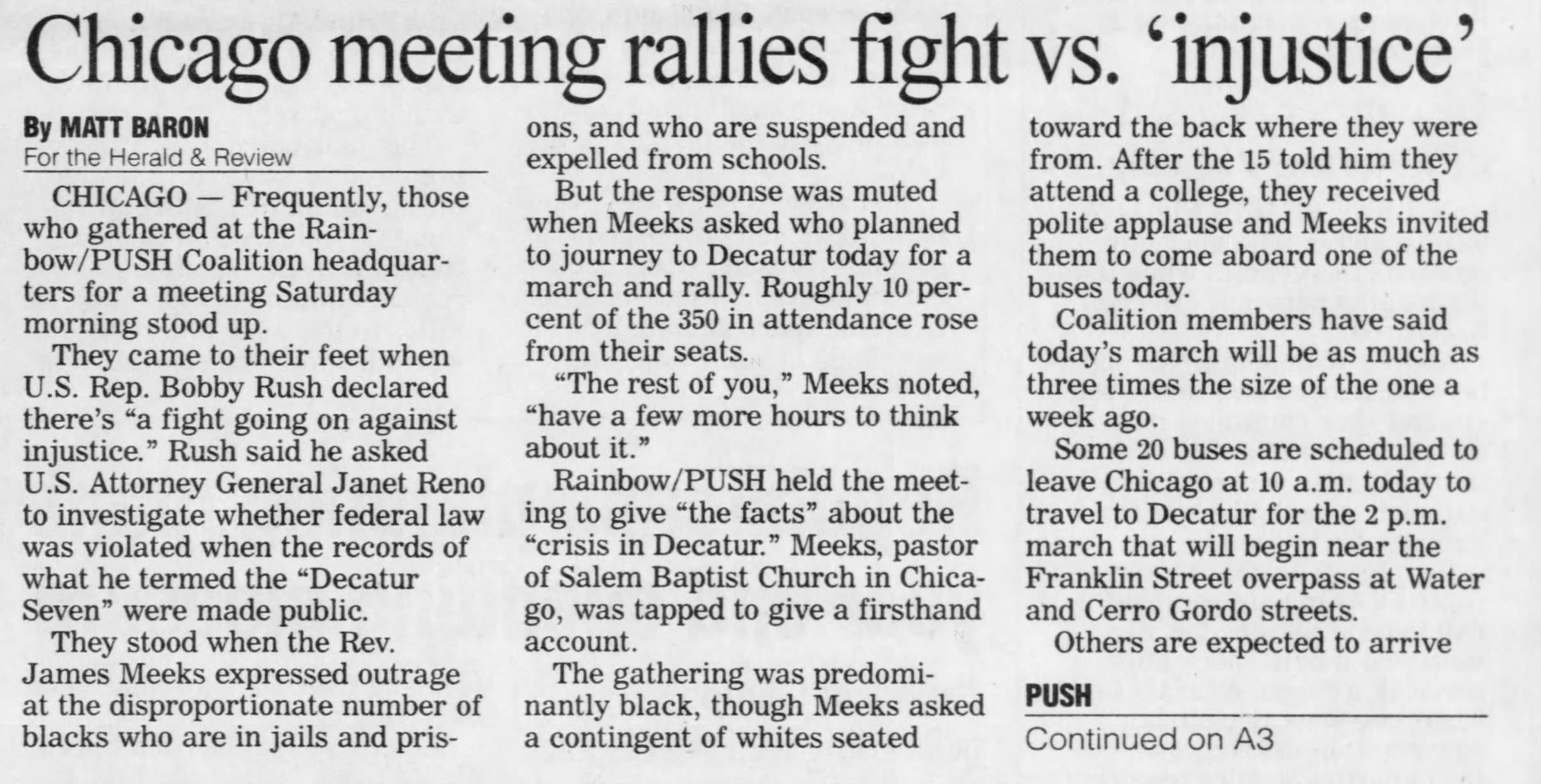
An already imposing 6-foot-3 figure, Jackson gazed down at me as if from a mountaintop. He’d led protests in Decatur days before, drawing national media attention and getting arrested on felony mob charges in the process. Now the conquering hero, a little over midway through what would become a 60-year public life, Jackson was in his element at the Rainbow/PUSH Coalition meeting.
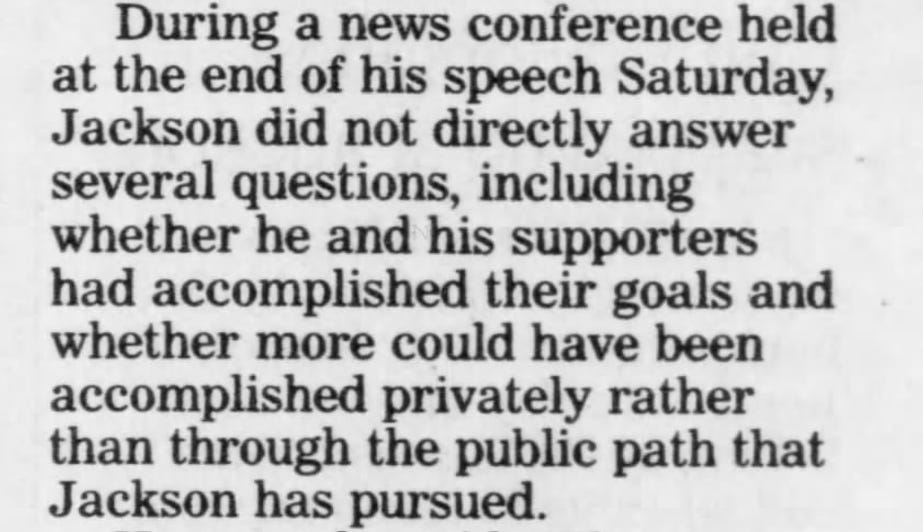
On assignment for The Herald & Review of Decatur that Saturday morning, I was literally looking up at Jackson as I hollered questions over the next few minutes.
“Do you feel you accomplished your goals?”
“Do you think you could have accomplished more through private dialogue?”
I might as well have asked him about the weather, or whether he thought his mustache played a role in his failed bid to become the first Black U.S. President the prior decade.
That’s because the ease with which Jackson utterly ignored my queries was stunning. Instead, he launched into whatever talking points were on his mind.
Initially, I thought he might have misheard or misunderstood me. But when he persisted in non sequitur fashion, my cameo role in his world crystallized: I’m just a prop, I thought. There was absolutely no “pivot,” public relations lingo for acknowledging a question before sidestepping it and moving the dialogue in another direction.
To that point, in my 15 years as a journalist and having interviewed hundreds of political and other public figures, I’d never had such an encounter. This man felt above even going through the motions of conventional communication.
Yes, Jesse Jackson headed a category of public figure occupied solely by himself.
Here’s how I boiled down the peculiar exchange:
But as the saying goes: Wait—there’s more! Get a load of what came next:
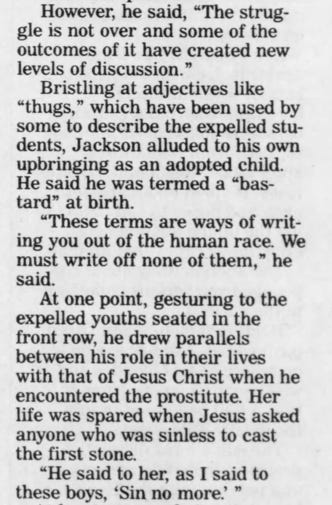
Gulp.
Did he just compare himself to Jesus Christ?
In fairness—and I really tried to be fair in my reporting—I decided that “drew parallels” was the way to phrase Jackson’s self-edification. There’s no question he was a civil rights champion. But the vibe he emitted that day was one of someone who, when peering into a mirror, convened a meeting of the Jesse Jackson Mutual Admiration Society.
As for that shoulder-to-shoulder identification he made with Jesus Christ, Jackson fell well short of God in the flesh’s perfect moral standard. For one thing: Born out of wedlock himself—recall the “b” word that he summoned that morning—Jackson had fathered a child six months earlier through an affair with a former Rainbow/PUSH1 staffer.
Only, that wasn’t public knowledge at the time. That scandal came to light about a year later, in January 2001, when the media-savvy Jackson sought to get out ahead of tabloid reports that were about to surface.
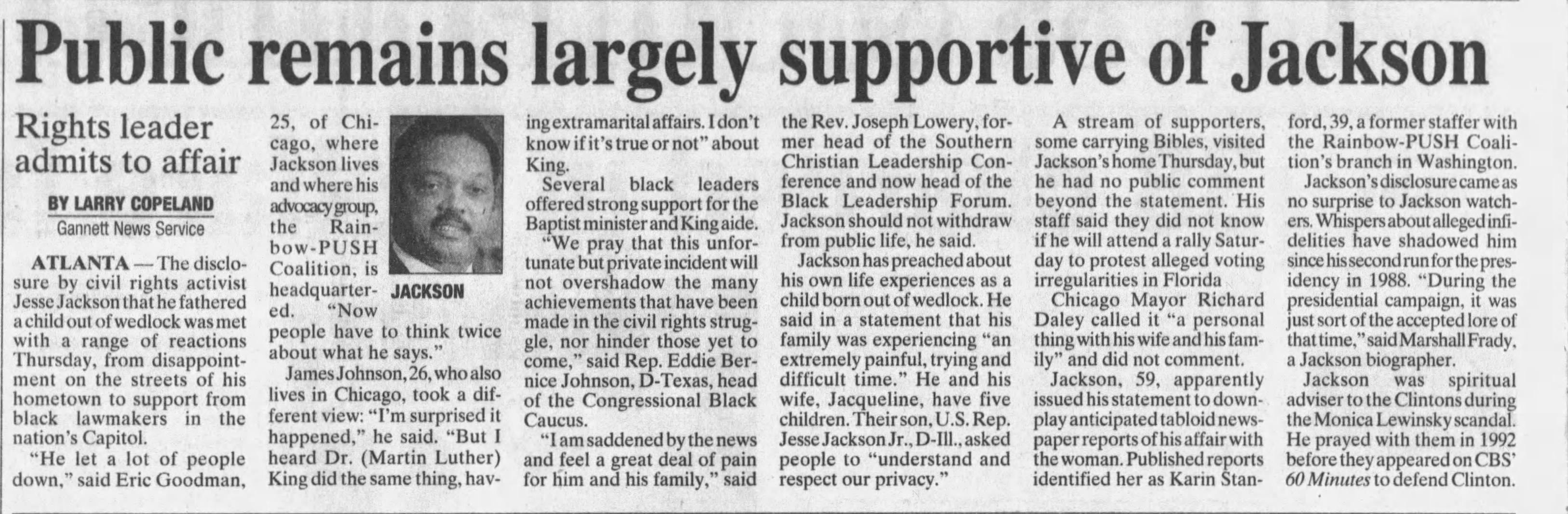
“I was born of these circumstances, and I know the importance of growing up in a nurturing, supportive and protected environment,” Jackson said. “So I am determined to give my daughter and her mother the privacy they both deserve.”
Meantime, Jackson’s very public marriage survived—he termed this period “an extremely painful, trying and difficult time” for his wife and their five children. It was a disappointing but not entirely surprising subplot in a remarkable life of a complex man who also achieved much good in the face of enormous racism and other forms of hostility.
Especially after being moved and inspired by his 1988 Democratic National Convention speech, I really wanted to admire Jackson. But between his well-chronicled penchant for self-serving publicity, his own personal failings and his bizarre arrogance toward me, my view of him was complicated.
As the years rolled on until his death this past week at 84, I settled into a respect and appreciation for the positive role this man played throughout the country and world, particularly in the arenas of social and racial justice.
May his shortcomings be a cautionary tale for us all, while we remember and honor the fruitful, genuinely Jesus-like aspects of his legacy.
Jackson, Duvall & …?
The deaths this past week of Jackson and Robert Duvall, at 95, sparked some other ruminations.
How I’ll always remember that Harvey Korman, the great comedian and actor, passed away at 81 years old on the same day as my dad, May 29, 2008.
How my mother-in-law passed away on the same day Harrison Ford nearly moved on from his mortal coil. On March 5, 2015, about 120 miles to her west, Ford survived a harrowing episode in which his plane crashed on a Santa Monica golf course.
How my wife had a brief connection with Duvall, through working on “Widows,” a Chicago-based film starring Viola Davis, Liam Neeson and Colin Farrell. It was shot in 2017, when Duvall (playing Farrell’s dad) was 86 years old. By then, he had been a movie legend for decades and, though in a smaller role, was still a presence to be reckoned with.
Among the 100-plus films Duvall appeared in, here are a few that I enjoyed: The Apostle, The Conversation, The Great Santini, Get Low and To Kill a Mockingbird—his 1962 film debut in which he played Boo Radley (below) and never spoke.
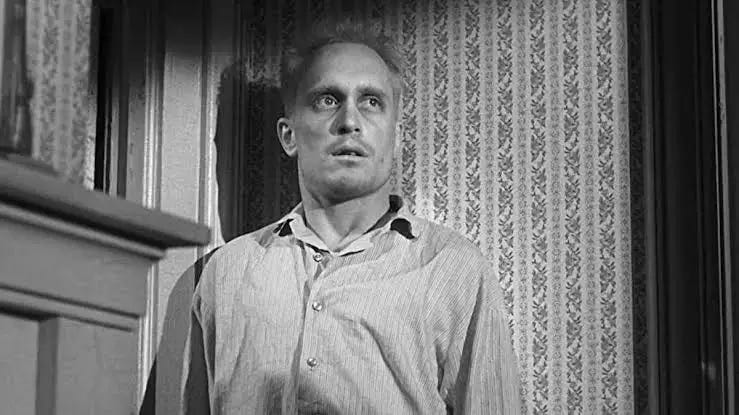
Only scratching the surface of his IMDB profile there. Of course, perhaps his most iconic role was Lieutenant Colonel Bill Kilgore, in Apocalypse Now.
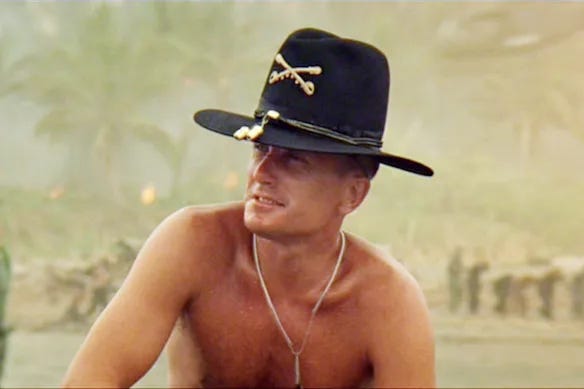
And the deaths of Jackson and Duvall prompt this one, final thought: Our tendency to think in terms of three when it comes to famous people’s deaths.
In this instance—and with the utmost respect to their lives—who would you consider to be the third person to link with Jackson and Duvall from the past few weeks?
Know what PUSH stands for? It’s People United to Serve Humanity.