
What are we missing?
As we consume so much lunacy, disinformation and divisiveness, vital stories go untold. Reflecting on my decades as a journalist, here's the psychology and practical reality behind why.

Journalists are like most anyone else in any other field: neither all good, nor all bad. We can be extremely ambitious and industrious; we can also drift to the path of least resistance.
Candidly, during my 20-plus years as a newspaper reporter, while I believe my peers would say that I was more often in the ambitious/industrious camp, it’s also true that I was prone to opting for the smoother path.
This underscores one of the most insidious aspects of today’s national media landscape: with so much attention devoted to the next installment of Shameless Shock and Fatal Flaw, so many other worthwhile stories—including exposure of other areas of governmental dysfunction—get back-burnered or buried altogether.
I’m just one guy, and during my career as a reporter, I was a relatively minor one in a sea of journalists. But today, sensing my experience is relevant to what we’re consuming on a regular basis, I want to offer a glimpse into the psychology and practical reality that influence which stories get massive play, which ones get overlooked, and everything in between.
Between 1984 and 2006—the bulk of my journalism career—I covered dozens of jurisdictions and hundreds upon hundreds of meetings for publications from the tiny to the medium-sized to the substantial. I interacted with hundreds of publicly elected men and women, some only briefly and others for years.
At 16 years old, I learned that when circumstances enabled chronicling (and sometimes egging on) a war of words between two or more public officials, it was almost always a no-brainer to go that route. Conflict is at the heart of compelling storytelling, after all, and it wasn’t as if I was creating the conflict.
No, I was merely reporting on it. In fact, it was my duty to shed light on these squabbles, especially when they affected public tax dollars.
As for those nuanced, complex issues that required extensive research and demanded more rigorous writing? Sure, I’d get to those topics, but a little later. Or much later. Or never.
In 1999, when I shifted from a newspaper staff to being a freelance reporter—and was paid by the story—my incentive to spotlight spats only grew.
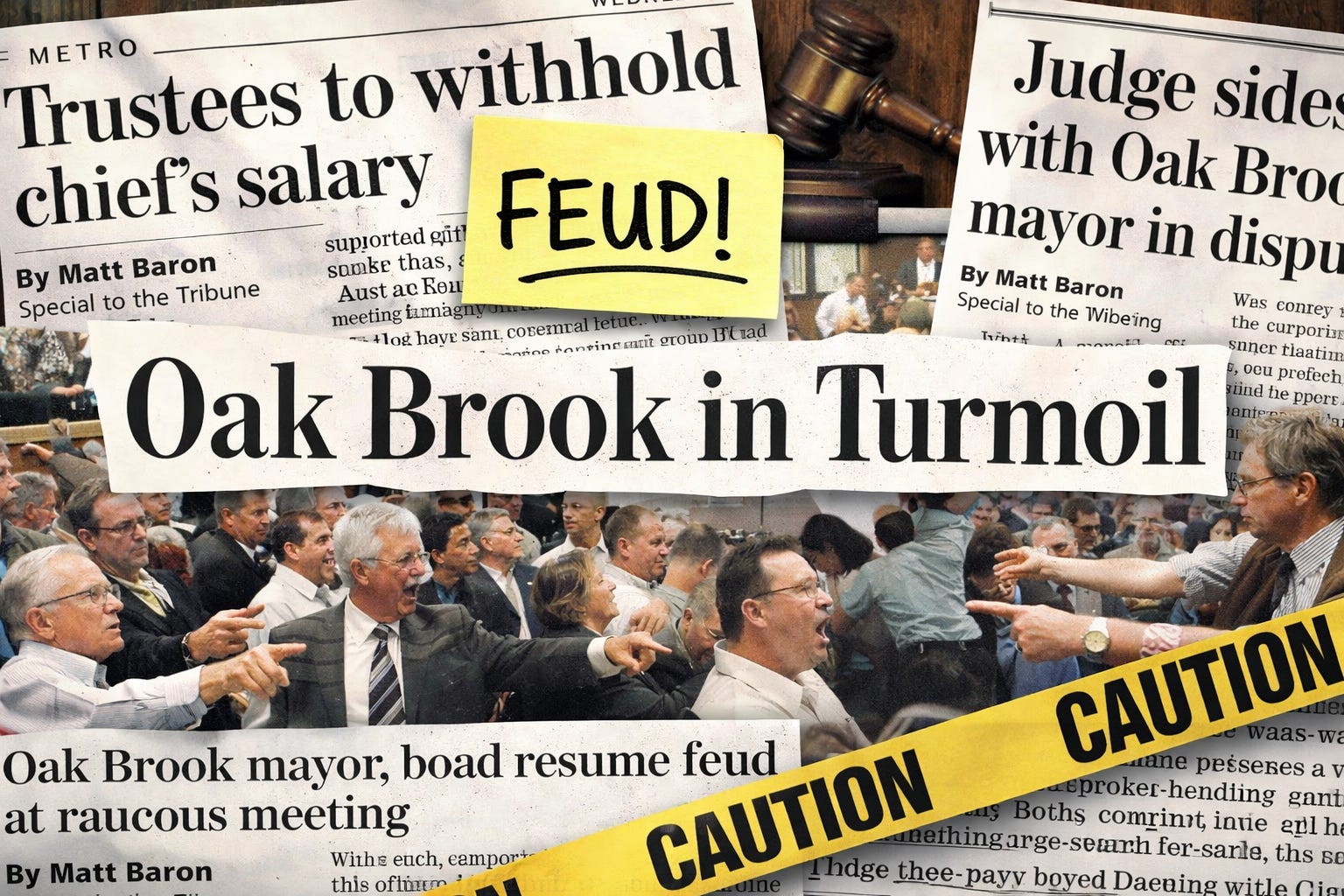
A quintessential case in point is from over 20 years ago, when I covered three communities for the Chicago Tribune. One was the historically corrupt Town of Cicero, always ripe for myriad stories of official bonkers activity. But the one that emerged as even more nutty was the usually sedate Village of Oak Brook.
My first few months of beat coverage there were pretty ho-hum. But that all changed when Kevin Quinlan was elected village president. He was a freelance reporter’s dream: someone whose force of personality, willingness to shake things up and media-friendly quotability generated news.
When he chose not to get trustees’ input before appointing an interim police chief, a soap opera of epic (if only local) proportions ensued. The process lasted over a year, involving lawsuits and other intrigue, with myriad twists and turns along the way. And, at a time when local news was still a staple of the Tribune’s coverage, all of it was dutifully chronicled by yours truly.
Happy to have identified a storyline that would help cover the rising cost of raising infant twins, this battle was manna from heaven. Being paid by the story meant a reliable flow of income as I built on prior chapters in the saga—a drama whose plot I was intimately familiar with because, in a sense, I was the playwright.
I chose what details made it in, and which ones didn’t. To be clear, I strove for fairness, accuracy and thoroughness. At the same time, integral to that fairness was underscoring the brewing rancor.
From the headlines, here’s a sampling of the “brouhaha,” a term I used regularly in my reporting of this chain of events.
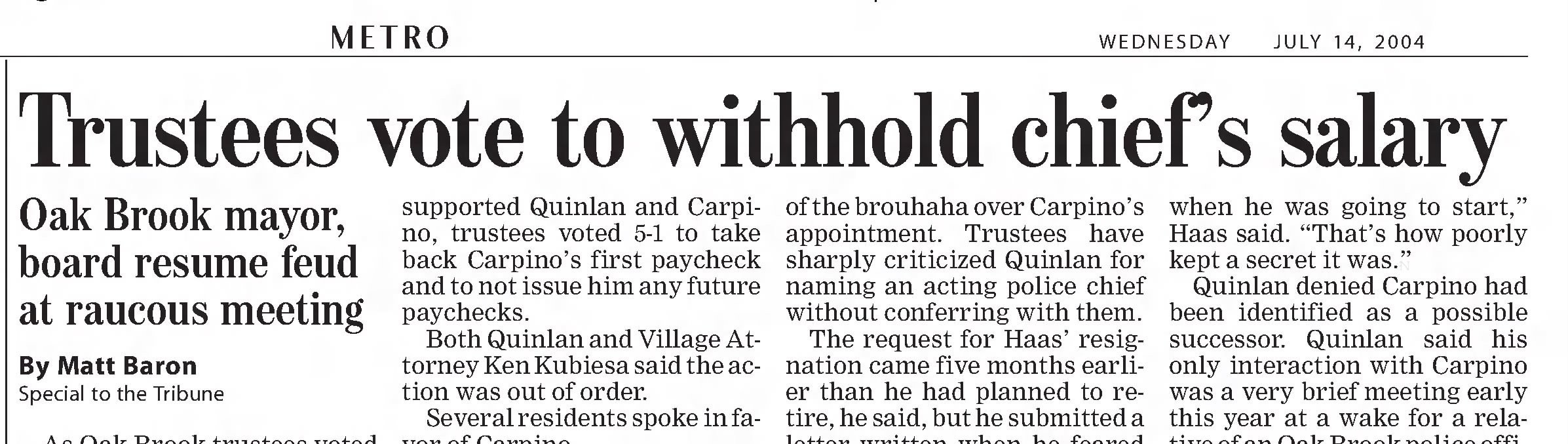

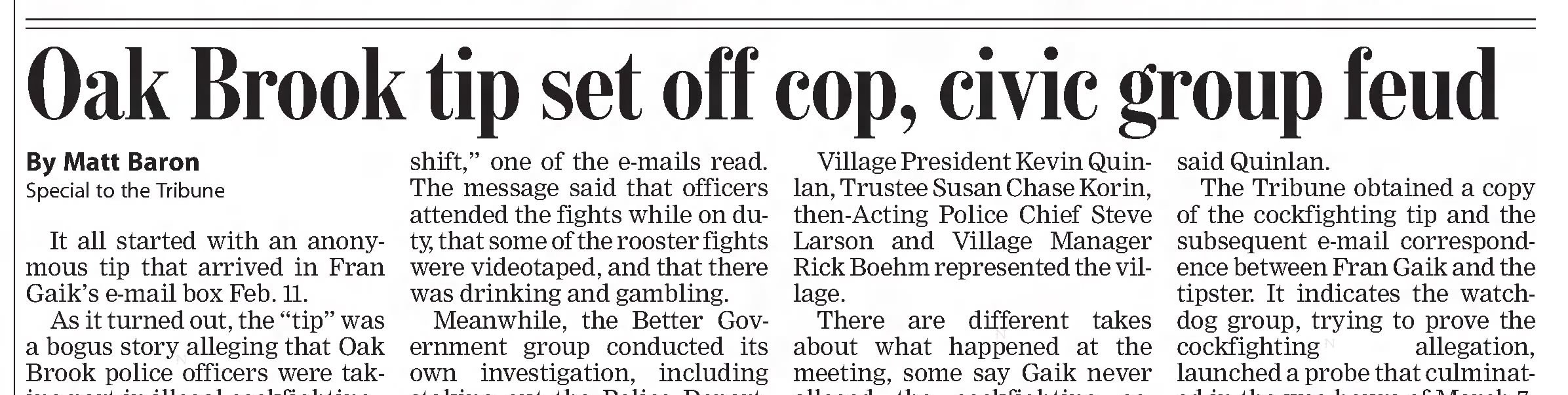
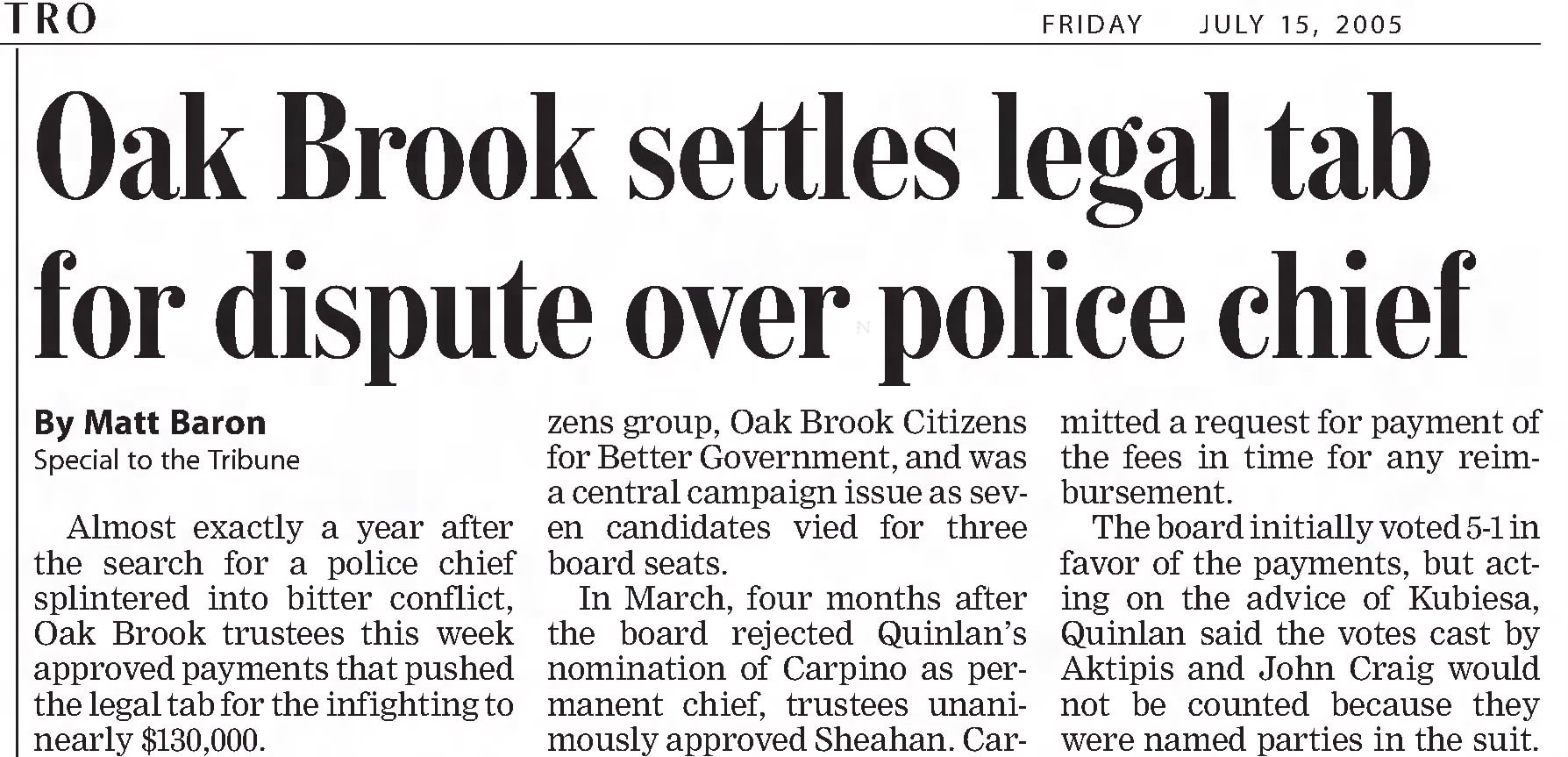
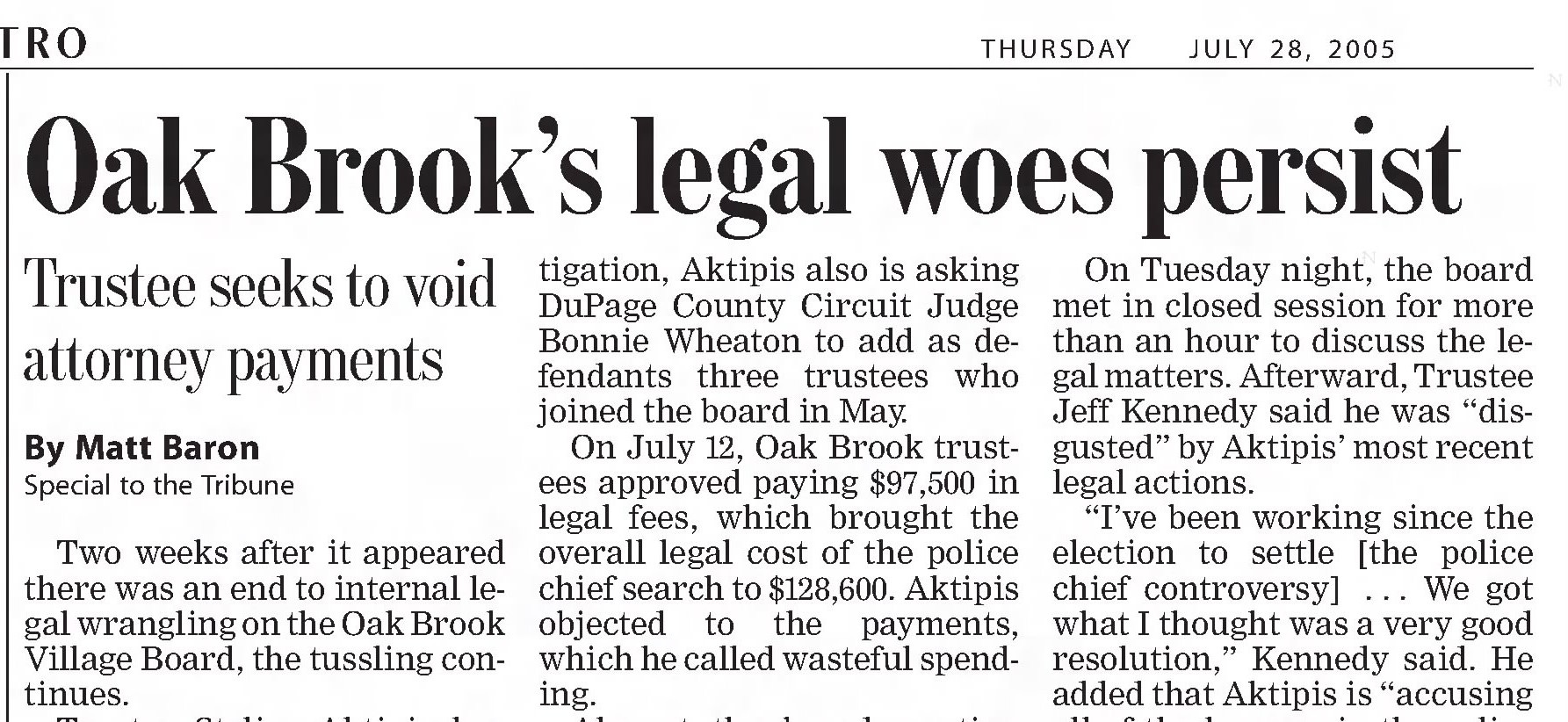
There was a lot more, too—these are just some of the highlights/lowlights. A related fiasco, stemming from a federal civil lawsuit filed by a couple alleging police harassment, wound up costing the village $2 million.
And there were hidden costs to the residents of this wealthy suburb, too. While I covered plenty of other topics along the way—the more, the merrier—there’s no doubt this running feud meant other stories went untold. This royal pissing match crowded out other issues that I didn’t have the time, or even awareness, to cover.
By 2026 metrics, it’s all pretty tame stuff, quaint in its own Mayberry-scaled way. Just the same, it’s what comes to mind when I muster the strength to check in on the 24/7 news feed of this historically fraught era in the United States.
I think about the insidious nature of the perpetual chaos and calamity being pumped into the national American news bloodstream. It’s a fast-moving train and so easy to stay on that well-worn track, both as a journalist and as a news consumer.
While we’re clicking on link after link of lunacy, misinformation, disinformation and divisiveness, we don’t even know what we’re missing. Among other things, we miss out on tales of inspiration or, at least, useful information that could lead to better decisions, whether individually or collectively.
One of the implications is that it means the overshadowing and outright obliteration of other stories that would be of exponentially greater value to far more people.
When the absurdity of a Greenland conquest is on page one, what’s getting pushed deeper inside the newspaper…or gets lost in the mix altogether? As much as the Jeff Epstein files have dominated news coverage, it’s inevitable that it has meant numerous other Trump administration cover-ups and instances of corruption fly below the radar.
Nationally, Republicans in recent years have demonstrated boundless capacity for cowardice and capitulation. But there are screw-ups, screwballs and other ne’er-do-wells on the other side of the aisle, too. Consider this: the Democratic Party is so imperfect that it botched the 2024 election against an aspiring dictator. And when it comes to egregious corruption, here in Illinois the Democratic Party has been a shameful standard bearer for decades.
As fellow news consumers, I encourage you to keep all this in mind as you choose between reading about another story in a long-running saga or learning about something entirely new—something that demands more of your reflection, more of your time, maybe challenges your worldview about a topic.
Ask yourself, “What are we missing?”
"Boundless capacity for cowardice and capitulation?" Look in the mirror buddy. For 3.5 years the Democrats (the meat puppets in the legacy press, Dr. Jill, Biden's closest associates, his personal physician) assured us that ole Joe Biden was as sharp as a tack; the best Biden ever (obviously a lie to anyone with eyes and a brain) but when ole Joe said he was going to run again in 2024 - contrary to his solemn campaign "promise" of 2020 - no one, not a one in the Democratic Party had enough balls or spine to say, "no you ain't." (Oh I forgot, there was one guy with balls and a spine, Dean Phillips who risked his whole political career in doing so). Finally, when the charade became completely untenable in June 2024, the party wise men and money men finally threw ole Joe under the bus. But by then it was too late to prevent the Orange man from completing his historic journey: the biggest political comeback in American history. Thanks Joe. And thank you brave, principled Democrats. Talk about "boundless capacity for cowardice and capitulation." Oh and here is another little tidbit for you and your brave fellow Democrats. On the upcoming 2028 Presidential debate stage if the Democratic nominee cannot answer "NO" to a simple question - can men get pregnant? - you can fergetaboudit.
As an aside. The reason both parties have a "boundless capacity for cowardice and capitulation" is what George Washington and John Adams feared and presciently predicted: that the formation of political parties would replace "loyalty to country with loyalty to party." They were right.
The Washington Post's daily "the 7" has won out for daily news for me. It has simply grown on me; I made no effort to select it. It would be even better if I had a Post subscription and could click on the links provided, but I don't. It skews towards health, but I admit that that is of interest to me. It certainly passes the practical test.
In general, there's no substitute, unfortunately, for just reading a lot of stuff. There's no perfect shortcut. The more you read, the more fortuitous and helpful connections you will make. Finding a new topic or a source is like finding a new friend -- pays off beyond just that day's discovery.
I don't think the fact that Trump is incompetent and corrupt and got elected means that the Democrats blew it in 2024. It's flawed reasoning. You are saying that the voters aren't 100% to blame and would have listened to some kind of reason. That may be true, it may not be. It's obvious our system isn't completely working, however large a problem one chooses to rate it. People don't want to look straight on at the fact that democracy is implicated, that right isn't winning. I think there needs to be some kind of scaling back and assurances that a Trump doesn't get offered to the people in the first place.
Or maybe it's just that we're quite far gone at this point. You had a primary where the vote was split among the non-Trumps in 2016 and his name recognition carried the day. Then he got in office and so did a lot of other corrupt people. Things are different now, the democracy became oligarchy. We perhaps have a democratic system, but not people who execute it to its purpose.
I suppose ultimately somehow we do have to have faith and hope that the voters will wake up or randomly vote the right way, do need to hope that the Democratic party really did blow it in 2024, because otherwise there is no hope.
There is also of course the issue of the Democratic system we thought we had on paper being contested and ignored by people with a motivated interest in understanding it differently.
What I'm trying to say about giving the Democrats something of a pass in 2024 is that I think what they did should have been 1000 times enough to get elected. Yes, I think they could have done nothing and deserved to be elected because of what anyone should be able to see about Trump. You can't judge their pitch by the outcome. If you want to criticize their pitch, do it on their pitch. Many have done that, but I must say, not always 100% convicingly to me. I read stuff about what the Democrats should do now or should have done then and it often sounds just like what they are doing.
The other thing is that pundits, say like if they are moderate, always think other Democrats should also be moderate. On that, though, I'm not sure I would have it differently. To be clear, I'm not a Democrat, but do I really think the party should do something different than what I think is right in the name of winning elections? Is an element of pure politics ever moral?