
Baronstorming Tour, Part II
A dispatch from the "Triple-ville" conclusion to our recent 12-day odyssey that wrapped up in Greenville, Asheville and, finally, Louisville. The common thread: I absolutely love museums.

Last week, after touching on a few highlights from the first half of our 12-day Baronstorming Tour, I promised:
More to come next week, covering the triple-ville last stretch of our journey: Greenville, Asheville and Louisville.
Sure, I’ll mention a few things—but it’ll be more “touching on” than “covering,” so don’t regard this as a thorough travelogue. Just a few tidbits before things fade fully from my memory…and which I hope are of some interest to you.
Maybe this is a preview of what you will encounter if you ever travel to these locales; or perhaps, if you’ve ever been to any of these places, you can compare these observations with your own experience.
Didn’t see my account last week? Check it out here.
Without further preamble, let’s get back on the road…
Day 7: May 20, Greenville, South Carolina
It was extremely hot, and mostly Bridgett and I were wondering why we decided to stop here in the first place. No offense to Greenville, but another 90 minutes on the road and we’d have made it to the next stop that held much greater interest for us: Asheville, North Carolina.
Given the heat, it was all we could do to survive a stroll (“stagger” is more like it—exhaustion was setting in) and that included going through lovely Falls Park, which has a rural hike vibe going for it.
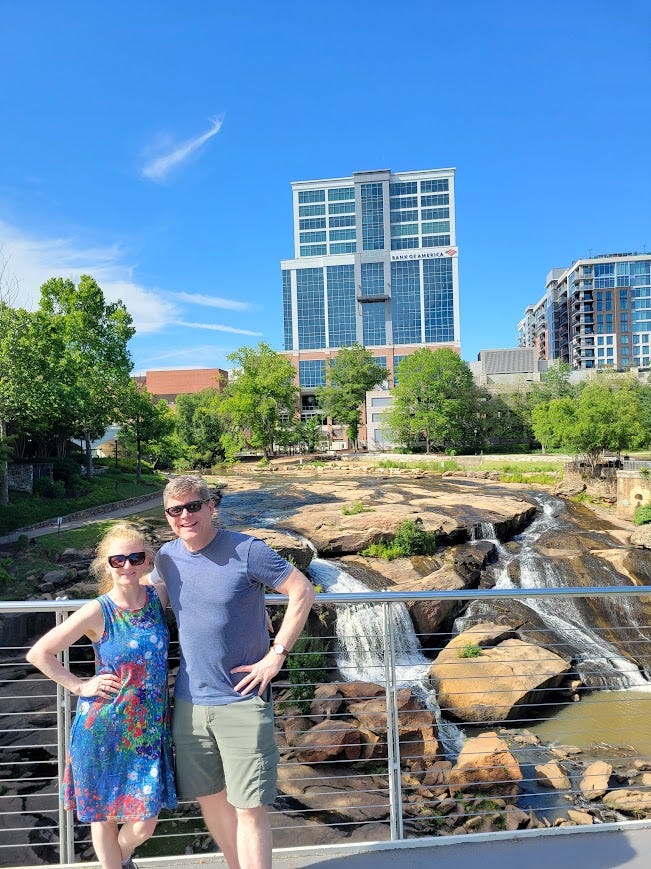
Eventually, we wound up retreating to a movie theater at the end of this day (“The Devil Wears Prada 2”—just so-so; I can certainly wait another 20 years for the next installment). Along the way, we went to the door of the Shoeless Joe Jackson Museum and Baseball Library.
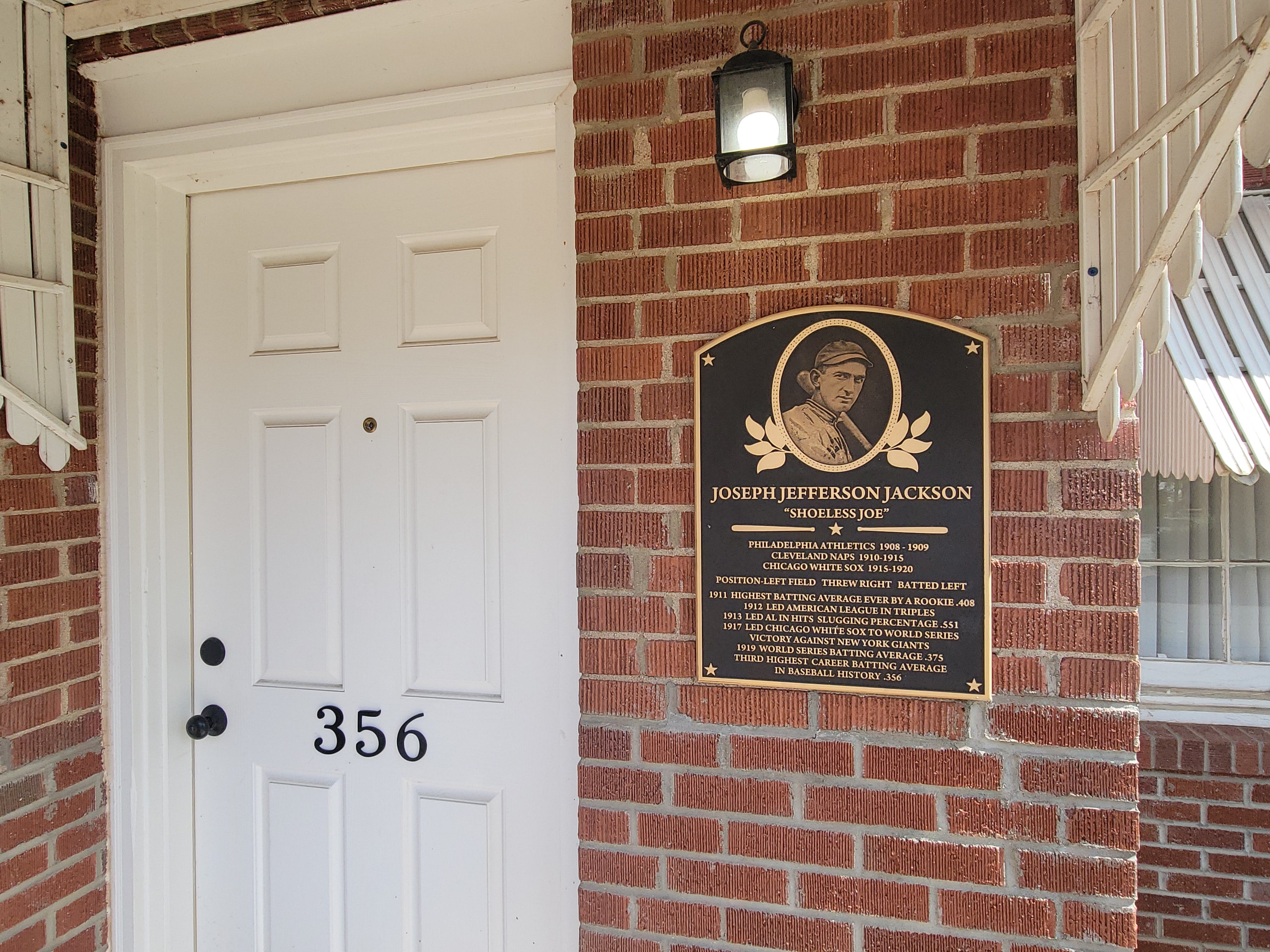
Pretty cool door and placard. Alas, the site is open for a mere four hours a week, from 10 a.m. to 2 p.m. Saturday (which we knew going in), so the door’s as far as we got.
As a big baseball fan, if we’d timed our visit a few days later, I’d have likely found a way to spend the entire four-hour window at this spot zooming in on the bittersweet baseball legacy of Jackson. He’s one of the game’s best hitters who was banned for life despite being acquitted of any crime in the “Black Sox” World Series game-fixing scandal of 1919, when the Cincinnati Reds beat the Chicago White Sox, five games to three.
Not exaggerating about my penchant for getting swept up in museums, either. This is true especially for topics I’m passionate about, but also for those for which I have mild or even no seeming interest (more on that later, about the Kentucky Derby Museum in Louisville).
Once inside a museum, I tend to stick around for as long as possible, exploring each and every nook and cranny while keeping an eye on the clock. For me, it’s a once-in-a-lifetime opportunity to get immersed in the subject.
Days 8 & 9: May 21 & 22, Asheville, North Carolina
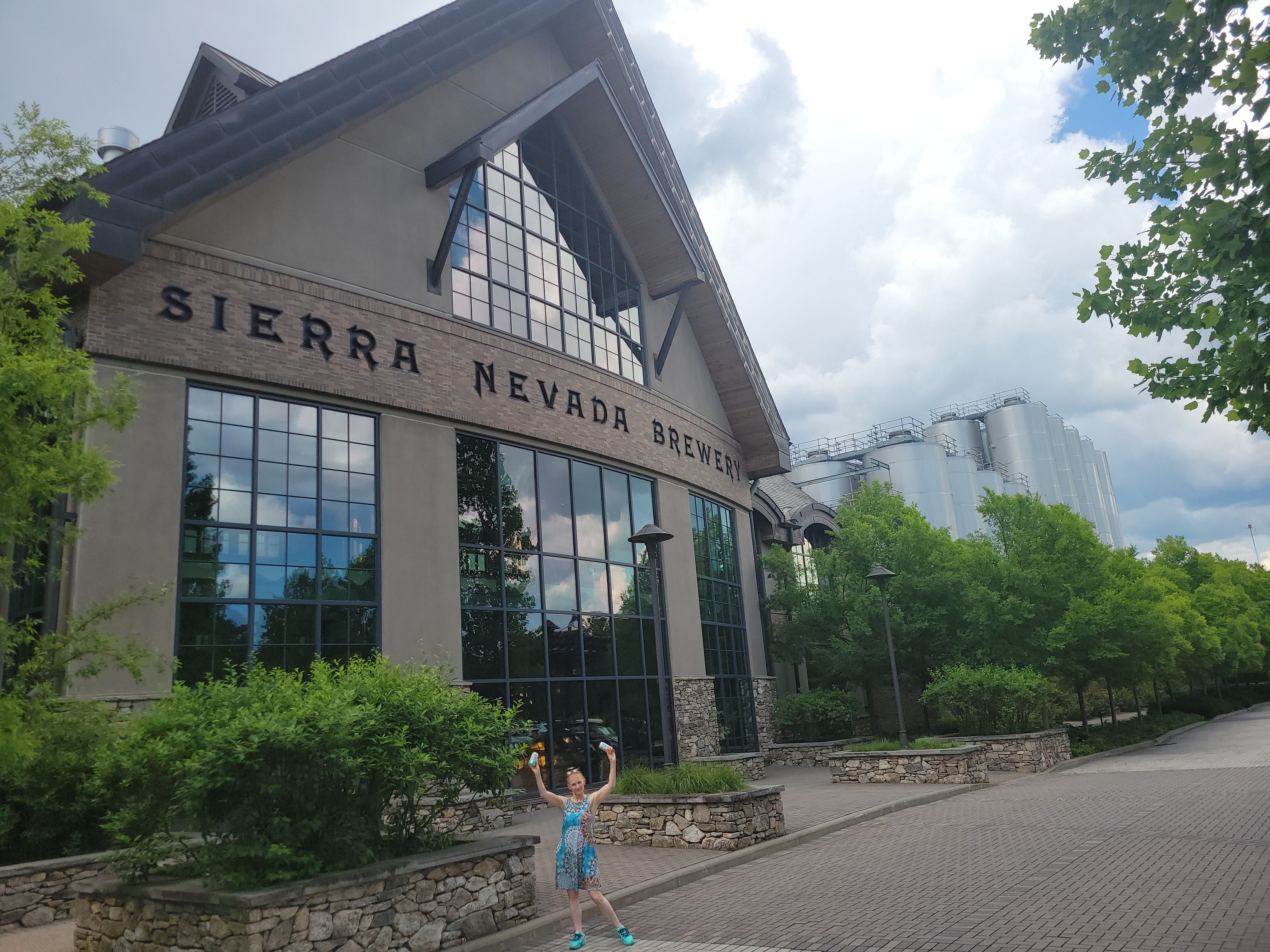
The next day, on the way into Asheville, signs along the highway alerted us to the Sierra Nevada headquarters in Mills River. An impromptu self-guided tour of this remarkable facility ensued.
This hadn’t been on our radar, and we enjoyed learning about the beer-making and -distribution process. So, we already felt “ahead of the game” in terms of our Asheville experience.
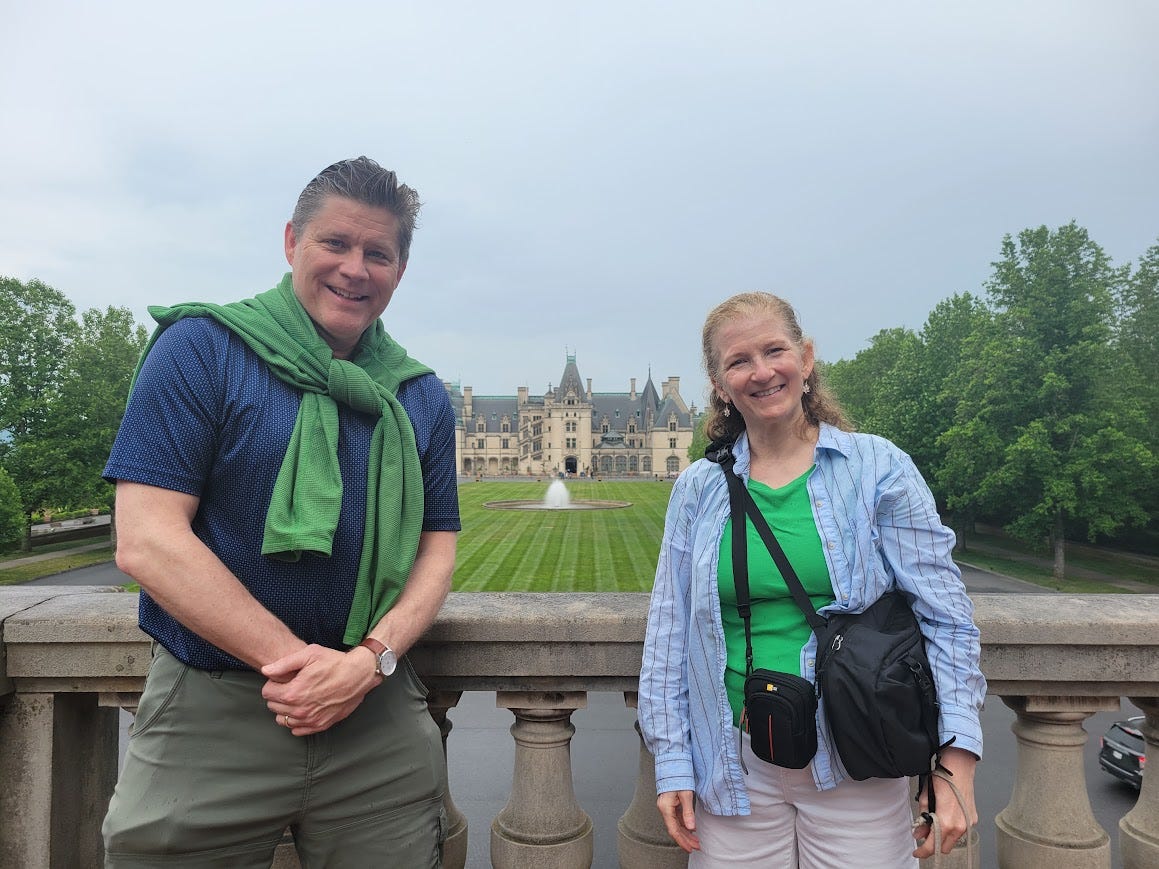
The next day, we visited the Biltmore Estate, the late George Washington Vanderbilt II’s magnificent 8,000-acre spread in Asheville, North Carolina. Ballyhooed as America’s largest privately owned home, the property is fascinating on so many levels.
For one thing, there’s the enormity of the undertaking in building it. About 1,000 people collaborated over a six-year period until 1895—at an estimated cost of $5 million to $6 million (around $200 million in today’s currency).
One section of the house is devoted to highlighting the construction process, including the myriad trade professionals who brought their skill and soul to this massive undertaking.
It all brings to mind the Hearst Castle in San Simeon, California (whose creation began in 1919), which we toured on our honeymoon in 1994.
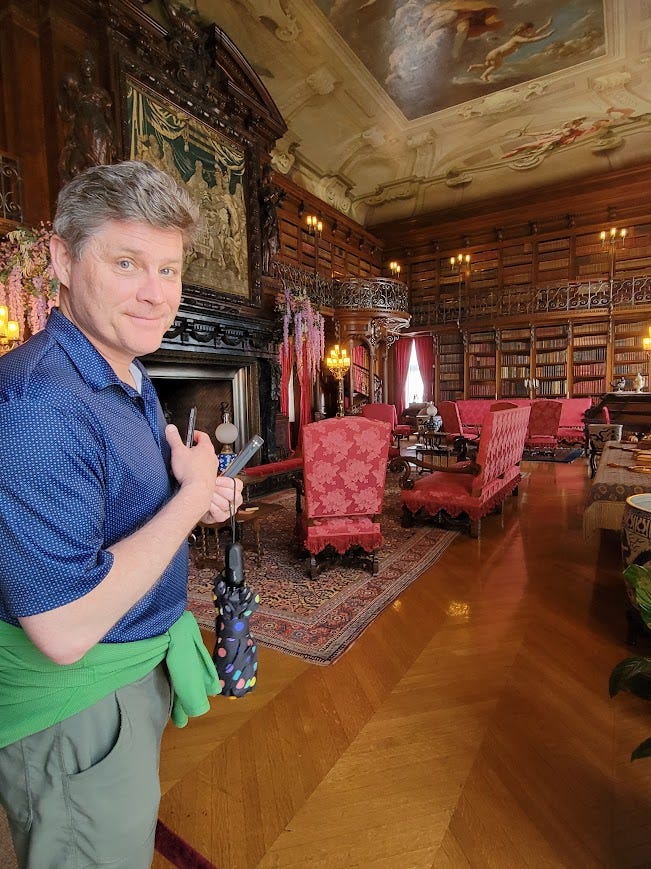
One lesson that can be gleaned from the Biltmore is that the passage of time has a way of reordering the spotlight. When Vanderbilt died of appendicitis at the age of 51, in 1914, one newspaper account referred to him as “the youngest and probably the least known” of the three Vanderbilt sons of William Vanderbilt.
That’s hardly the case anymore.
Days 10, 11 & 12: May 23-25, Louisville, Kentucky
Two museums were the centerpiece of this last stop on the Baronstorming Tour.
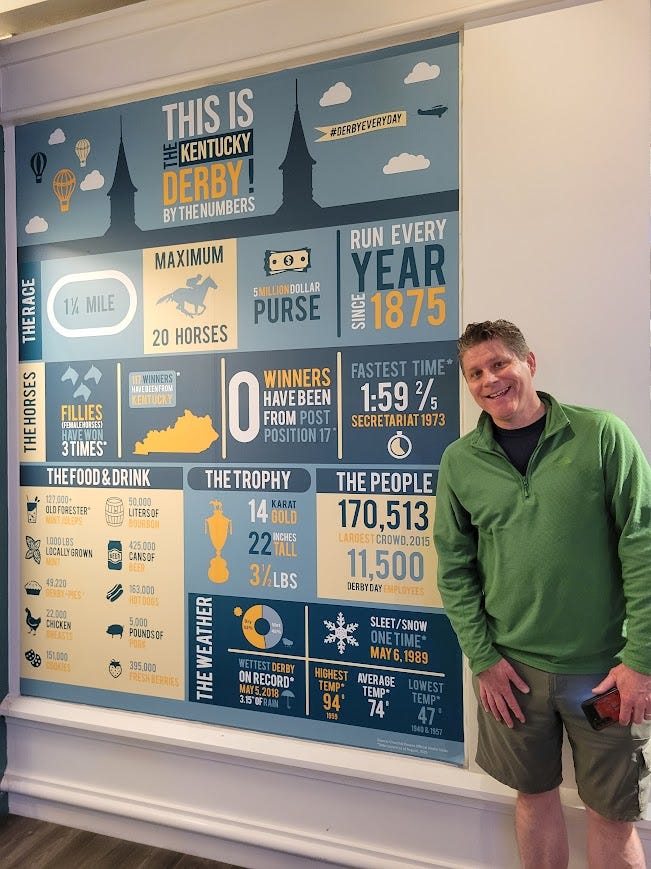
The first was the Kentucky Derby Museum, which was fascinating and moving—there was a movie that actually made Bridgett cry and moistened my eyes in a non-allergy-related way.
I’ve never been much into horseracing1, but what drew me in here—and it’s the same thing that tugs at me in other seemingly unlikely places—are all the stories of struggle and achievement. Individual stories, collective stories…and, in this case, Thoroughbred stories like that of legendary Secretariat, winner of the 1973 Triple Crown (Kentucky Derby, Preakness Stakes and Belmont Stakes).
This whole business of going to museums has me pondering: Why do we do it? Is it to accumulate more knowledge? To be entertained?
I believe it’s partly that, but at least for me, it’s more the childlike joy that comes from exploring and encountering something in a personal way that we get to curate. I can’t possibly look at every display, let alone read every detail, try as I might.
But I can nibble over here and feast over there while skipping that other section completely. (I’m looking at you—by not looking at you—International Horseshoeing Hall of Fame inductees.)
And I can dig deeper later, too—simply snap a photo (or 20) for later reference.
The net effect of our excursion is that today, I care much more deeply about the Kentucky Derby than I did only a week ago. That interest was fanned by behind-the-scenes moments that we enjoyed, including close-up views of three races (see one video below) and conversations we had with folks who work there.
Our next outing on the Louisville museum front came the next day: the Muhammad Ali Center, which opened in 2005. I’ve been keenly interested in Ali’s life for many years. That includes reading two books about him (Jonathan Eig’s Ali: A Life and Running With the Champ, by Tim Shanahan).
I don’t see eye-to-eye with many of Ali’s views. And he was far from perfect. But there is plenty to respect and admire about him, such as his kindness to people he encountered and his courage in standing up for his beliefs (most notably refusing to enlist in the military, resulting in a 3 1/2-year professional boxing ban).
Increasingly over the course of his life and in the decade since his death, Ali’s positive global influence as a philanthropist is beyond dispute.
Part of my interest in Ali can be traced to his being a darling of Sports Illustrated coverage, and appearing on dozens of SI covers, over his legendary career. That overlapped with my coming of age as an adolescent sports journalist who consumed SI virtually cover-to-cover, as noted in this column two years ago.
With that as a backdrop, let’s wrap up this incomplete account with one final video clip from the road in which I linger along all those Sports Illustrated covers inside the Muhammad Ali Center.
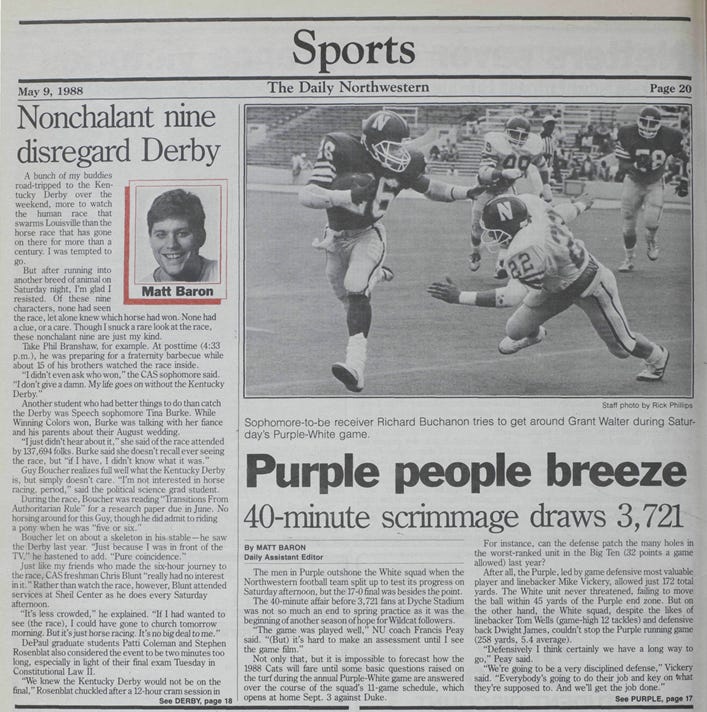
My interest in the Kentucky Derby certainly far outstrips how I felt 38 years ago, when I wrote this column in The Daily Northwestern about the “nonchalant nine” students who shared my indifference to the event.
A Few Last Things…
Your feedback is always appreciated. Hit the “LIKE” button below if you enjoyed this post and please leave a comment.
Is there a topic you’d like to see me write about in the future? Let me know by leaving a comment. Feel free to forward this along to someone else you think might enjoy it.